

Silent letter rules are not random quirks. They’re fragments of English history preserved in spelling. Many words still hold letters that once carried sound, linking modern forms to Old French, Latin, and early Germanic roots.
Linguists note that a large portion of common vocabulary includes silent letters because writing is conservative while speech evolves faster.[1] Once you see the pattern, silence reveals structure. Let’s uncover the real logic behind silent letter rules.
Why Silent Letters Exist at All: A Short History of Sound Change

English once pronounced everything you see on the page. Middle English sounded out clusters like kn, wr, gh, and mb, producing words such as knight with a velar fricative and write with an audible w.
Over time, sound changed faster than spelling. Between the 15th and 17th centuries, the Great Vowel Shift radically altered long vowels, while the new printing culture froze earlier spellings.[2] Latin and French prestige reinforced older orthography, which created silent letter patterns as speech simplified.
The result is a system where writing preserves history: letters mark origins, separate look-alikes, and signal meaning relationships long after their sounds disappeared.
The Hidden Work of Silent Letters
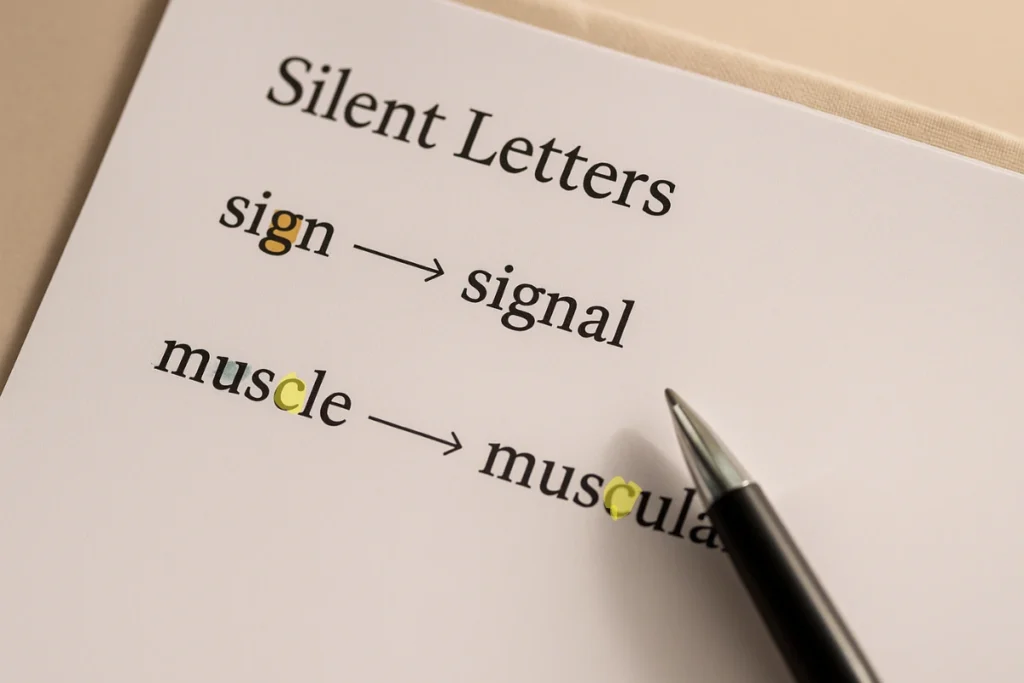
Silent letters look useless, until you see what they’re doing. This section shows how English orthography rules turn “silence” into structure.
1. Etymological Memory
Silent letters keep a word’s ancestry visible. Debt traces to Latin debitum, psychology to Greek psyche. The unpronounced forms act like family signatures that link modern spelling to historical roots without needing explanation.
2. Morphological Clarity
Silence can expose relationships. Sign shares g with signal and signature; the letter makes the semantic network obvious. In muscle → muscular, the silent c anticipates the sound shift, keeping the word stable across forms.
3. Vowel Regulation
“Silent” letters often regulate sound: rat → rate, hop → hope, sid → side. The final e lengthens the vowel. It proves silence can still shape pronunciation. Even unheard elements regulate rhythm and reading expectations.
Beyond these roles, silent letters act as structural markers in the writing system. They separate homophones (knight/night), guide stress, and reveal influence from French scribes who preserved older norms when printing froze spelling.
Instead of mistakes, they represent English negotiating between speech and history.
Silent Letter Patterns You Can Actually See
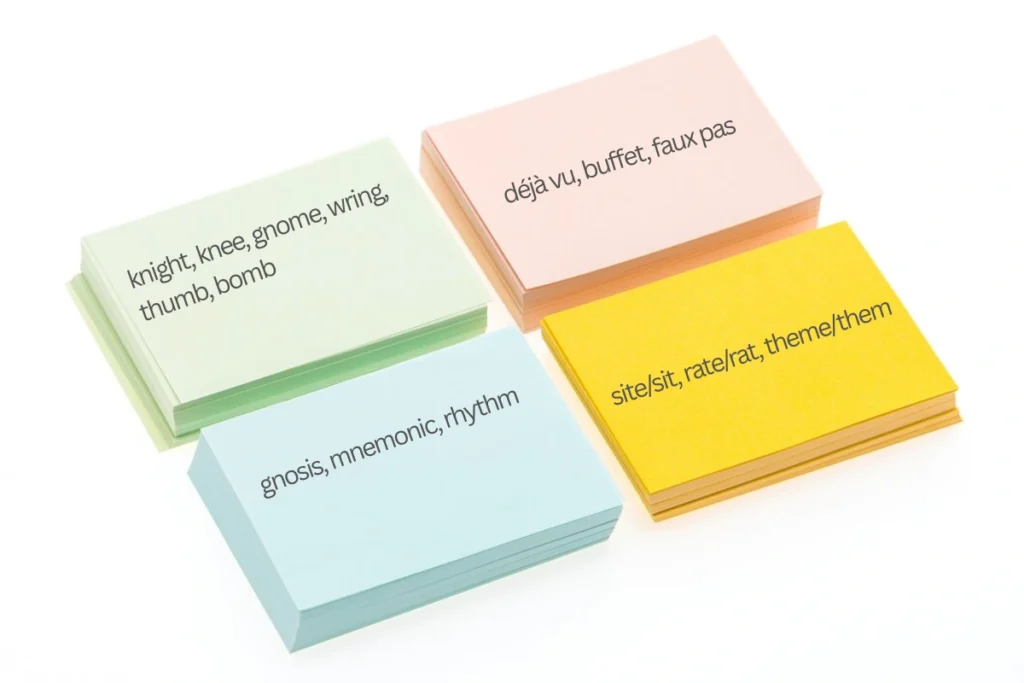
Silent letters follow recognizable patterns once you know where to look:
1. Cluster Residue: kn, gn, wr, mb
These clusters were once fully pronounced in Middle English—reminding us English once sounded heavier. Over centuries, sounds eroded while spelling froze through printing.
Examples: knight, knee, gnome, wring, thumb, bomb
2. French Prestige Spellings: ballet, bouquet, coup
French loanwords entered English as cultural prestige markers. The silent letters preserve their heritage rather than reflect English phonology.
Examples: déjà vu, buffet, faux pas
3. Greek/Latin Scientific Roots: pneumonia, psychology, corpus
Silent letters often reveal specialized ancestry. Academic and scientific terms retained Greek/Latin patterns for clarity across European scholarship.
Examples: gnosis, mnemonic, rhythm
4. Silent e as Vowel Ruler: hope vs hop
The “silent” e regulates vowel length and meaning contrast. It acts morphologically: altering pronunciation, signaling tense, or guiding inflection.
Examples: site/sit, rate/rat, theme/them
From a historical linguistics English perspective, these are visible traces of how English absorbed other languages, simplified sounds, and kept spelling as a record of meaning networks rather than a mirror of speech.
From Quiet Letters to Clear Logic
The moment you recognize phonological reduction as history in action, English stops feeling random. Silent forms become clues: each one connects etymology and spelling, meaning-families, and ancestral sound.
You move beyond memorizing spellings into understanding the logic beneath them. And with guided practice, reading, speaking, and real feedback, you build that intuition faster.
Join our English programs for kids ,teens, and adults to experience this clarity in context. Learn the story behind silent letter rules—start today!