
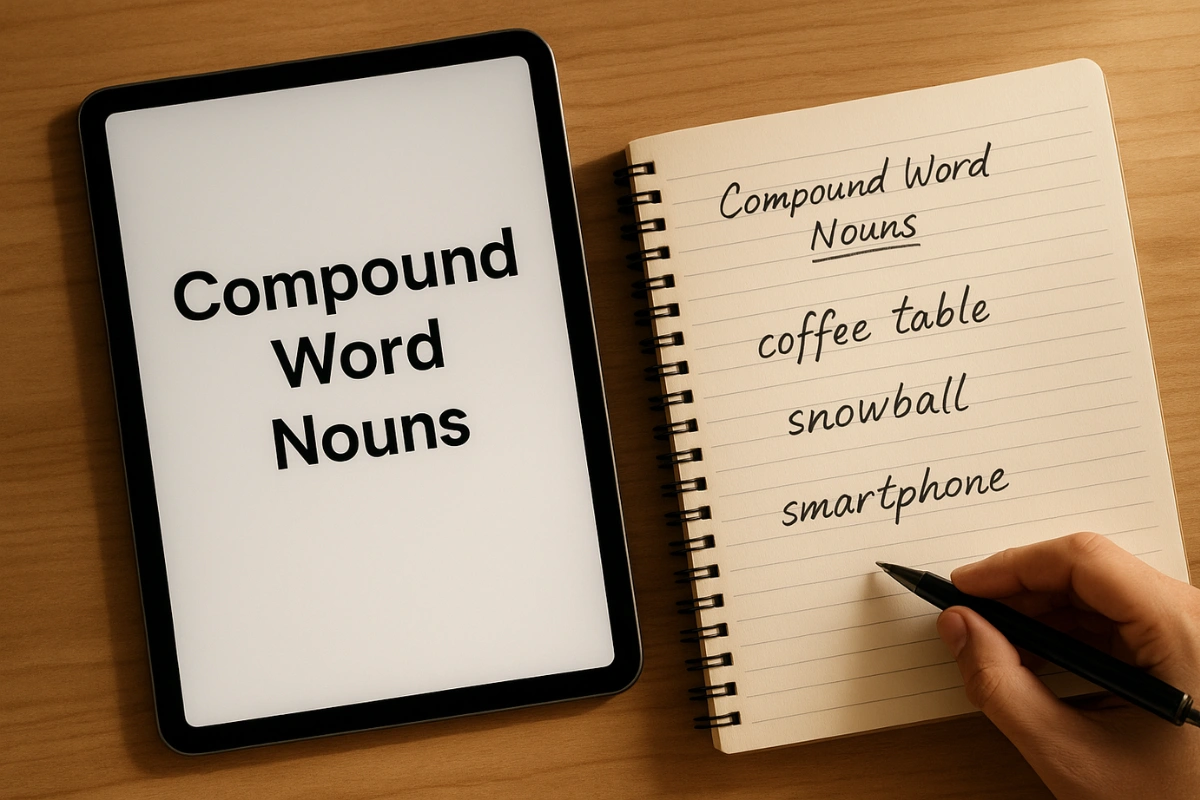
Compound word nouns are one reason English evolves faster than almost any other language today. As technology, culture, and global conversations expand, the Oxford English Dictionary now adds more than a thousand entries each year[1], and many come from two simple words fused into one new idea.
A compound noun is beyond grammar. It’s a tiny story where meaning merges. Stay curious because understanding how ideas combine will change how you see compound word nouns!
The Anatomy of a Compound Noun

A compound noun might seem like two nouns stacked together. However, they are a semantic unit designed to express a single object, role, or event. Linguists describe this as a head-modifier structure. The final element (the head) names what the thing is, while the first element (the modifier) reshapes its category.
For example, a coffee table is still a table, defined by purpose; a snowball is a ball, defined by material and form. Behind this simplicity, the semantic relationships vary widely. Researchers describe anywhere from a small handful to more than forty types, depending on whether they focus on cognitive linguistics, computation, or morphology.[2]
The important takeaway isn’t memorizing categories, but recognizing how English effortlessly builds new concepts by merging familiar meanings into a single linguistic unit. Once you see compounds as meaning-fusion rather than grammar labels, their forms become intuitive.
The Three Forms: Closed, Hyphenated, Open — and Why They Exist

The forms of compound nouns are less about “rules” and more about lexical evolution—how often speakers use a combination until it functions as a single idea.
Closed compound nouns like bookstore or notebook represent the end of that journey because the pair has fully merged into one word. Hyphenated forms such as mother-in-law or long-term are transitional. The visual link helps reading while the meaning is still settling.
Open compound nouns like high school or post office operate as paired concepts that haven’t merged orthographically, yet function semantically as one unit.
Over time, high-frequency compounds tend to compress in form. The shift from e-mail to email or from web site to website reflects how digital vocabulary stabilized through repeated use.
The interesting part is that these forms don’t change because a committee decides them—they shift because millions of speakers unconsciously converge on simpler shapes.
The Sound Signature: How Stress Reveals a Compound

English often identifies compound nouns through stress, not spelling. Even across different types of compound nouns, primary stress falls on the first element: BACK-pack, SEA-food, GREEN-house. This contrasts with adjective + noun phrases like green HOUSE, where meaning splits rather than merges.
Research in English phonology shows that stress is one of the strongest cues for compound recognition [3], which is more reliable than hyphens or spacing. Hearing that pattern lets you sense when two words function as a single conceptual unit, even before you analyze form.
Why New Compounds Keep Appearing

New compound nouns exist because English grows by recombining familiar ideas into new concepts. Instead of inventing roots, speakers fuse meaning quickly: cloud storage, smartphone, data breach.
Linguistic surveys show compounds are a major engine of vocabulary growth.[4] One analysis found compounds made up 39.8% of new entries, while the other reported 54.5%.
Also, compounds spread fast because society meets new tools and risks as well as habits. Language, on the other hand, responds instantly. Thus, compound nouns examples are snapshots of innovation.
Compound nouns show how you can think in English, not just translate it. Two simple words fuse into one new idea, revealing how language grows with culture and technology. Once you understand that logic, vocabulary stops feeling endless and starts making sense.
At Fun English Course, you can learn that mindset through real conversation and structured coaching—classes are available for beginners to advance learners. Start today—and unlock English through compound word nouns.