

Do you think that separable and inseparable phrasal verbs sound boring? However, mastering this grammar term might lead you to sound natural while speaking English. These tiny verb + particle combinations—like turn off, run into, or bring up—appear everywhere, from Netflix dialogues to business emails.
Research shows speakers use a phrasal verb roughly every 150 words in conversation.[1] Thus, understanding separable and inseparable phrasal verb structures is beyond optional—it’s essential for fluency.
What “Separable” Really Means
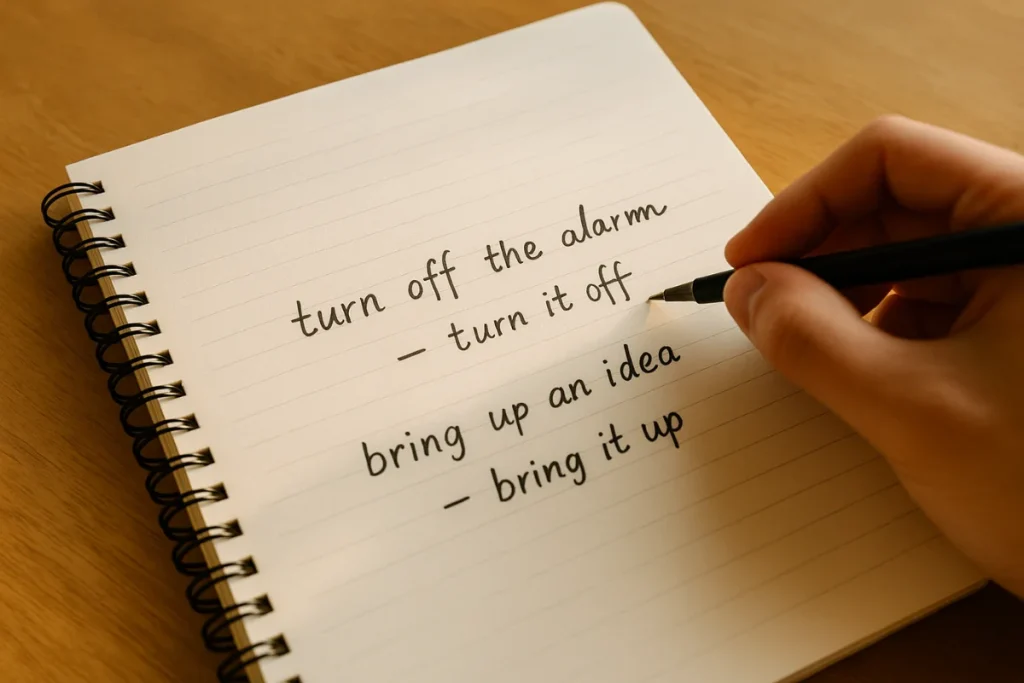
When you find a phrasal verb and the object can split the verb and its particle, then it is a separable type. Structurally, it appears as verb + object + particle. The key is that when the object is a pronoun, a separable phrase verb is required.
Check out the examples below:
- Turn off the alarm – turn it off.
- Bring up a new idea – bring it up.
- Hand in your project – hand it in before noon.
This flexibility gives English its dynamic flow and emphasizes either the action or what’s being acted upon. On the other hand, understanding this logic is essential before exploring the difference between separable and inseparable phrasal verbs in depth.
Why Some Phrasal Verbs Can’t Be Split

Unlike separable ones, inseparable phrasal verbs keep both the verb and particle together as one fixed unit. Splitting them, on the other hand, would break the meaning entirely. These combinations often go beyond literal action, which nuances make English expressions richer.
Check out these examples:
- Get into trouble – to “find oneself in a problematic situation”.
- Come across as rude – describes how someone is perceived by others.
- Stick to the schedule – to “follow consistently without changing”.
Such patterns are deeply rooted in idiomatic English, and you commonly find them woven into stories and lyrics or conversations alike. It makes learning inseparable phrasal verbs examples more relevant these days, especially when it comes to catching the rhythm of how English feels, not just how it’s built.
When Rules Bend: The Gray Area Between Both
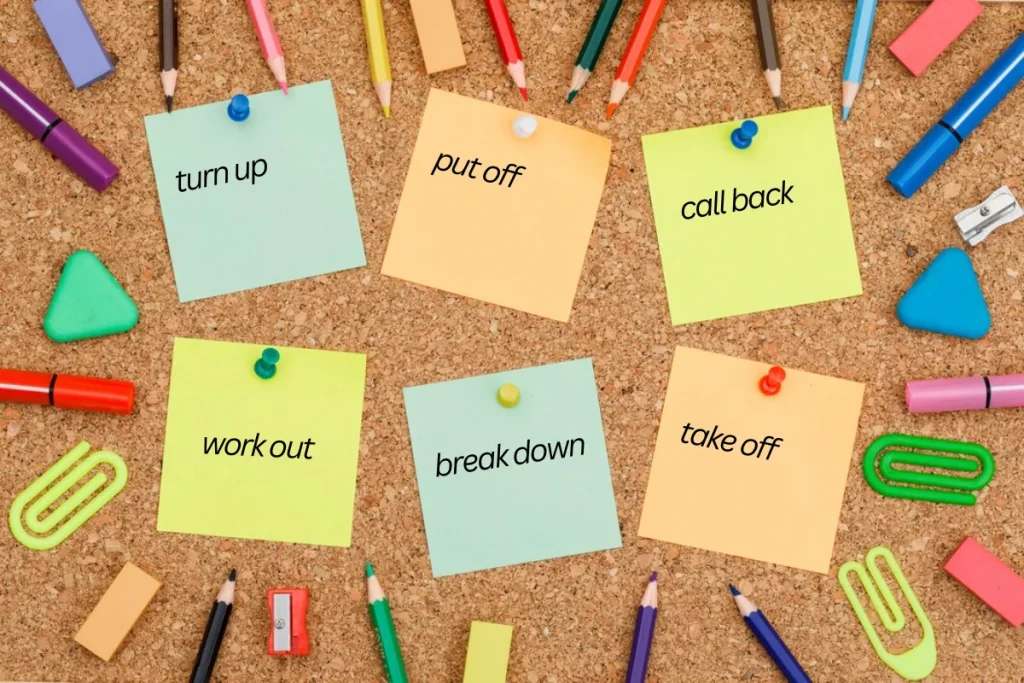
Even though most of the verbs are well-categorized, some of them refuse to stay in one box, which makes English interesting. A phrase can act as separable or inseparable while shifting meaning accordingly based on the context.
Several phrasal verb examples below may enlighten you:
- Put off → They put off the meeting (separable, “postpone”) vs. I get put off easily by rude people (inseparable, passive or idiomatic).
- Turn up → He turned up late (inseparable, “arrived”) vs. Turn up the volume (separable, “increase”).
- Show off → She showed off her new tattoo (separable, literal) vs. He’s always showing off (inseparable, no object, habitual).
- Call back → I’ll call back later (inseparable, “return a call”) vs. Call her back (separable, “respond to someone”).
- Work out → Things worked out fine (inseparable, “resolved”) vs. Work out the answer (separable, “solve”).
This fluidity shows why context matters more than memorizing a separable phrasal verbs list. Once you see how meaning evolves with usage, you’ll stop translating and start thinking like a fluent speaker instead.
Making English Feel Alive with Phrasal Verbs

English is dynamic—thanks to phrasal verbs for providing every sentence movement and rhythm along with personality. You’ll hear them slip in naturally, whether online or in any show. Words like show up, carry on, let down, sort out—all of them are beyond describing actions.
A study also reveals that phrasal verbs appear nearly twice as often in spoken English as in formal writing,[2] which becomes essential if you want to sound, think and express emotion like native speakers.
Take your chance to master this structure in a fun yet elaborate way at Fun English Course. We provide various classes—from beginner to professional levels, including our specialized conversation program.
Call us now and learn more about separable and inseparable phrasal verb structures to speak like natives.